

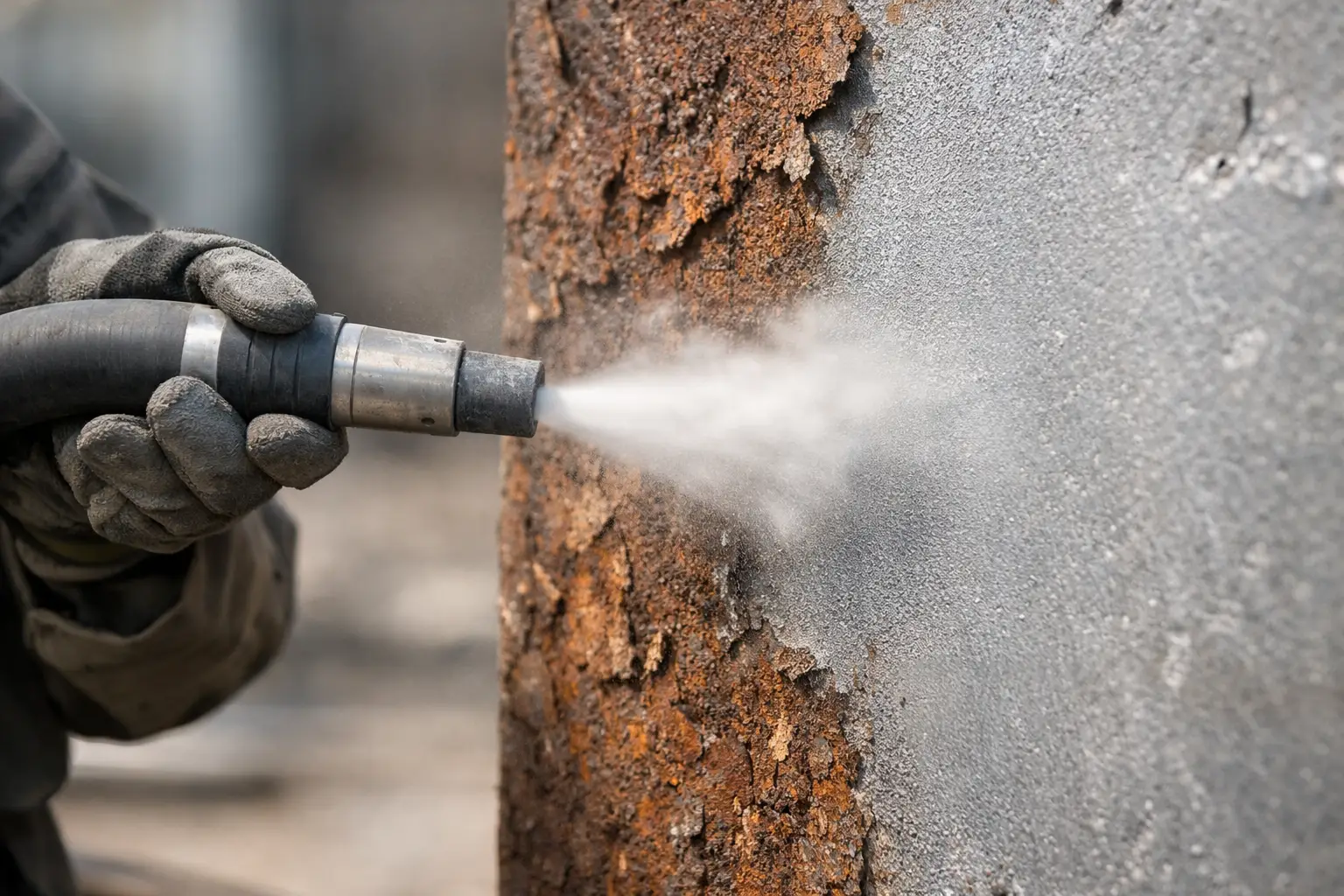
A steel gate covered in peeling paint may look like a painting problem. Often, it is a surface-preparation problem first. If loose coating, rust, mill scale, or embedded grime remains underneath, a fresh finish has nothing solid to hold onto. So, how does sandblasting work? It uses a controlled stream of abrasive material, propelled at high speed, to remove unwanted material and leave a surface ready for repair or coating.
Despite the name, professional sandblasting does not always use sand. The abrasive media, air pressure, nozzle size, and operator technique all change based on the material being cleaned and the finish the project requires. A truck frame, brick wall, aluminum part, and antique metal railing should not all be blasted the same way.
How Does Sandblasting Work in Practice?
Abrasive blasting equipment combines compressed air with a selected blasting media. Air from a compressor moves through a blast pot or pressure vessel, where it picks up the abrasive. The mixture travels through a heavy-duty hose and exits a nozzle at high velocity.
When those particles strike the surface, they break up and remove contaminants. Depending on the media and pressure, the impact can strip old paint, cut through rust, remove scale, clean corrosion, or create a textured profile for a new coating. The operator controls the nozzle angle, distance, and movement to clean consistently without unnecessarily damaging the substrate.
Think of it less like spraying cleaner and more like controlled mechanical abrasion. The process is powerful because thousands of particles are hitting the surface every second. It is precise only when the equipment and approach are matched to the job.
For a heavily rusted steel component, the goal may be to remove corrosion down to clean metal and create enough texture for primer to grip. For masonry restoration, the goal may be much gentler: remove failed paint or staining while preserving the face of the brick and the mortar joints. Both are abrasive blasting, but they require very different settings.
The Main Parts of a Blasting Setup
The compressor provides the air volume and pressure needed to move abrasive effectively. Pressure matters, but air volume is just as important. A system that cannot maintain enough airflow will lose cutting power and produce inconsistent results.
The blast pot holds and meters the abrasive. A valve controls how much media enters the air stream. Too little abrasive can make the work slow; too much can reduce efficiency, clog equipment, and make it harder to maintain a clean blasting pattern.
The hose and nozzle deliver the abrasive to the work surface. Nozzle size affects production rate, while nozzle shape affects the blast pattern. As a nozzle wears, its opening grows, which changes air demand and can reduce control. Professional operators monitor this because worn components can affect both job quality and operating cost.
Containment and dust-control equipment are also part of the process. Blasting can create significant dust and spread debris well beyond the immediate work area. Depending on the site, a project may require tarps, barriers, recovery systems, or other controls to protect nearby property, people, and finished surfaces.
The Abrasive Media Makes a Major Difference
“Sandblasting” is commonly used as a general term, but there is no single blasting material that suits every project. The right media depends on the substrate, the coating being removed, the desired finish, environmental conditions, and whether the material needs to be recovered.
Hard, angular media cuts aggressively and can create a sharper surface profile. It is often useful for steel with thick rust, scale, or tough industrial coatings. Rounder media tends to peen or clean rather than cut as deeply, which can be helpful when a smoother finish is needed.
Some jobs call for gentler materials, such as soda, crushed glass, plastic media, or agricultural media. These can be appropriate for selected restoration work, delicate parts, or surfaces where limiting damage matters more than maximum speed. However, gentler does not automatically mean better. Media that is too soft may fail to remove the coating efficiently, while media that is too aggressive can pit metal, erode masonry, or distort thin panels.
Silica sand presents a serious respiratory hazard and is not the default choice for professional work. Safer, purpose-selected alternatives are commonly used instead. The material removed from the surface can also create hazards, especially when old coatings may contain lead or other contaminants. That is one reason blasting should start with an assessment, not an assumption.
What Happens to Rust, Paint, and Scale?
Rust is iron oxide, and it does more than discolor metal. It expands as it forms, lifting paint and allowing moisture to work farther beneath the coating. Blasting removes visible rust and helps expose the sound metal below. If deep corrosion has already reduced the thickness of the metal, blasting will reveal that damage, not repair it. Holes, thin spots, and weakened edges may need welding or replacement before finishing.
Paint removal works in a similar way. Abrasive impact fractures and lifts the old coating from the substrate. Multiple paint layers, thick epoxy coatings, and weathered industrial finishes can take more time and a more aggressive approach than ordinary exterior paint.
Mill scale is a dense layer that forms on hot-rolled steel during manufacturing. It can look dark, smooth, and intact, but it is not always a reliable base for a long-lasting coating. Blasting removes mill scale and creates a more uniform surface for primer or protective coatings.
Surface Profile: Why Clean Is Not the Only Goal
A surface can look clean but still be poorly prepared for paint. Coatings need the right surface profile - a controlled microscopic texture that gives primer something to grip. This is often called an anchor pattern.
The required profile depends on the coating system. A thin coating may not tolerate a deep, rough profile, while a high-build industrial coating may need more texture to bond properly. The blast media, pressure, nozzle distance, and travel speed all influence the final profile.
This is where the trade-off matters. Aggressive blasting can be faster on heavy steel, but it may be excessive for thin metal, decorative pieces, or soft masonry. A professional approach focuses on the condition of the substrate and the next step in the project, not simply on making the surface look bare as quickly as possible.
The Surface Must Be Protected Quickly After Blasting
Freshly blasted metal is clean, exposed, and highly reactive. In humid conditions, flash rust can begin surprisingly fast. That is why blasting and coating should be planned as connected steps. If a metal surface will be primed, the primer should be applied within the coating manufacturer’s recommended window.
Before coating, the surface may need to be blown down with clean, dry air and inspected for remaining dust, abrasive residue, oil, or missed corrosion. If contamination is left behind, even a premium paint system can fail early.
For masonry, wood, and other nonmetal surfaces, the next step may be different. The material might need washing, drying, repairs, sealing, or a compatibility check before any finish is applied. The right follow-up depends on what was blasted and why.
When Sandblasting Is the Right Choice
Abrasive blasting is a strong option when ordinary cleaning, scraping, or wire brushing cannot remove corrosion and failed coatings effectively. It is commonly used on railings, gates, trailers, equipment, structural steel, automotive parts, masonry, and durable restoration materials.
It is not always the best answer. Thin sheet metal can warp from heat or aggressive impact. Historic brick can be permanently scarred by the wrong media. Surfaces with active oil contamination may need degreasing before blasting, and certain coatings require special testing and containment. The best method depends on the surface, its condition, and what needs to happen after it is cleaned.
Blasting also requires serious safety controls. Abrasive dust, coating debris, high-pressure equipment, and rebound particles create real risks. Proper respiratory protection, eye and hearing protection, protective clothing, site containment, and trained operation are part of doing the work responsibly.
The value of sandblasting is not simply that it removes what is old. It gives restoration, repair, and protective coatings a clean foundation to work from. When the media and method fit the project, the finished surface is ready for the work that will make it last.